

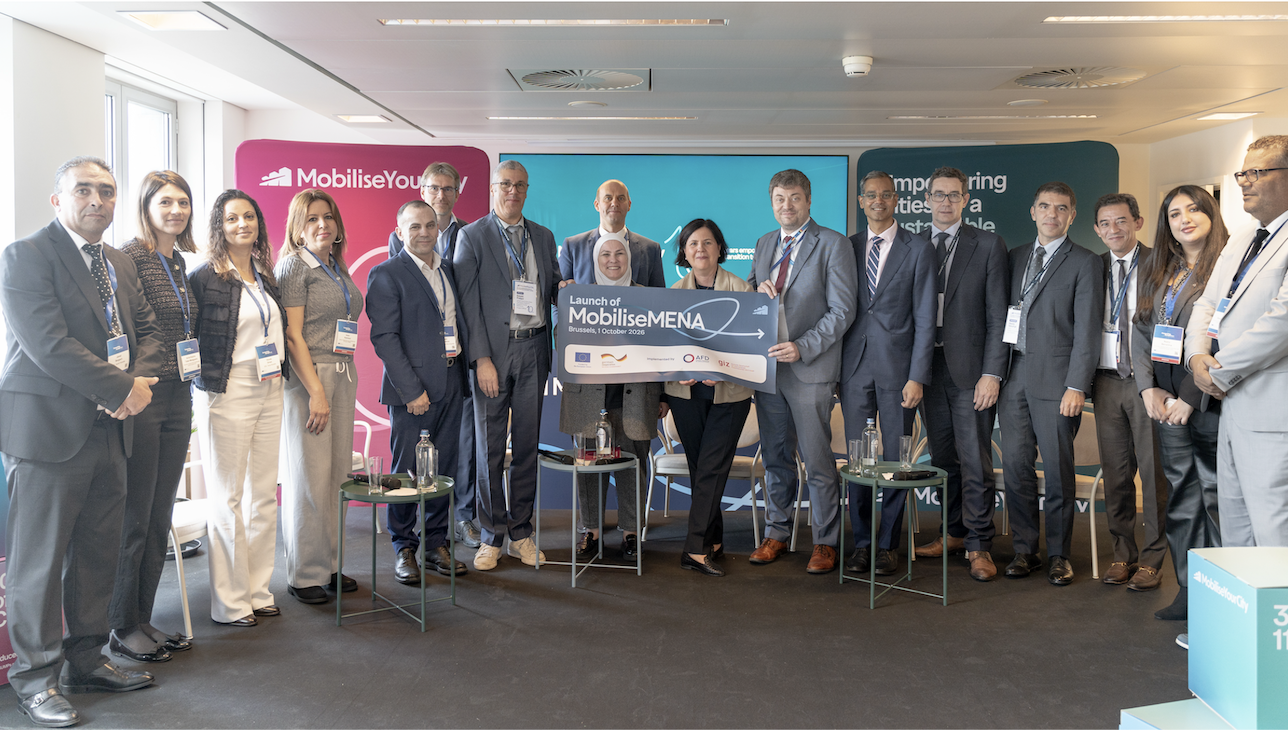
Launch of MobiliseMENA
On October 1st, 2026, the project MobiliseMENA was officially launched at MobiliseYourCity’s 10-year anniversary event. The new project takes the lessons from a decade of MobiliseYourCity and brings them to the Middle East and North African region. In the words of Es-Said Fraigui, Head of the General Secretariat of the Fonds d' Accompagnement des Réformes du Transport Routier Urbain et Interurbain (FRAT) in Morocco, “ten years after the launch of MobiliseYourCity, we are pleased to embark together on a new chapter of cooperation, one that builds on the achievements of the past, supports innovation, and further strengthens the link between planning, project preparation, financing, implementation, and evaluation.”
As part of the launch, a delegation from Tunisia, Morocco, and Jordan joined several site visits around Brussels. The city is implementing its current regional mobility plan while preparing the next one, which has made it a good place to see both progress and remaining challenges.
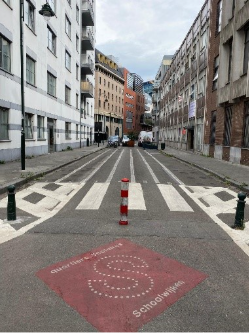
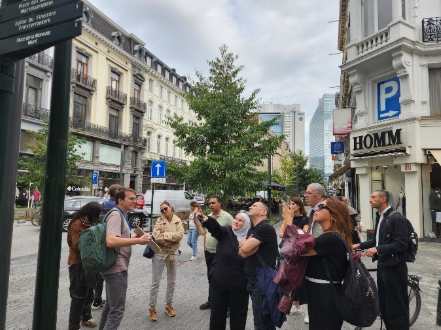
Transformation in Progress in the City Centre
The visits began with a discussion with Bruxelles Mobilité, the region’s mobility authority, which presented the progress on its Regional Sustainable Urban Mobility Plan. A walking tour of the city centre then showed the plan on the ground, including where it is working and where it isn’t yet. Topics ranged from large-scale pedestrianisation, safe school zones, and greening of public spaces to logistics delivery zones, and to Brussels’ upcoming ban on shared e-scooters. Before and after pictures showed that the city centre has experienced a dramatic shift away from cars in the past two decades – but that a lot of work still remains to be done.
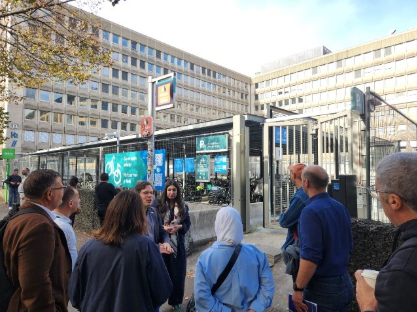
One Station, Many Modes
At Gare du Midi, one of Brussels’ main transport hubs, the Belgian National Railway Company (SNCB) showed how a station can integrate different ways of travelling. The delegation visited the bike parking station, the shared mobility hub, and the ticketing system, always with intermodality in mind. Although many modes come together at the station, passengers rarely notice the connections, which is entirely by design. Another highlight was seeing how the station creates an accessible user-friendly navigation system while considering the country has three official languages!
The Last Mile by Cargo Bike
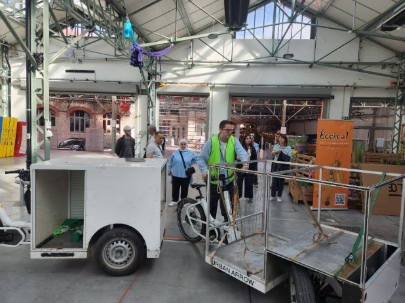
The final visit took place at the business centre BE-HERE and focused on urban logistics. One initiative stood out: Recyclo, which delivers food to restaurants across Brussels and collects their organic waste, all by cargo bike. The visit demonstrated how local hubs closer to the city centre can complement traditional distribution centres on the city’s edge, cutting both emissions and congestion. Seeing several cargo bike models up close highlighted a challenge that will increasingly matter to planners: many streets and cycle lanes are not yet designed with logistics vehicles, such as wide cargo bikes, in mind.
Not every Brussels solution will fit Tunis, Tanger or Amman. What the delegates took home was a clearer picture of both the successes and the stumbling blocks. Cities in this region are in their own process of rapid transformation and have much to show others in return. That is the idea behind MobiliseMENA: not to export one model, but to connect cities that can learn from each other.
About MobiliseMENA:
Co-funded by the European Union (EU) and Federal Ministry for Economic Cooperation and Development (BMZ) and jointly implemented by GIZ and AFD, MobiliseMENA supports national and local authorities in developing and implementing Sustainable Urban Mobility Plans (SUMPs) and National Urban Mobility Policies and Programmes (NUMPs). The support includes technical assistance in selected countries, as well as regional capacity development initiatives (until June 2029).