

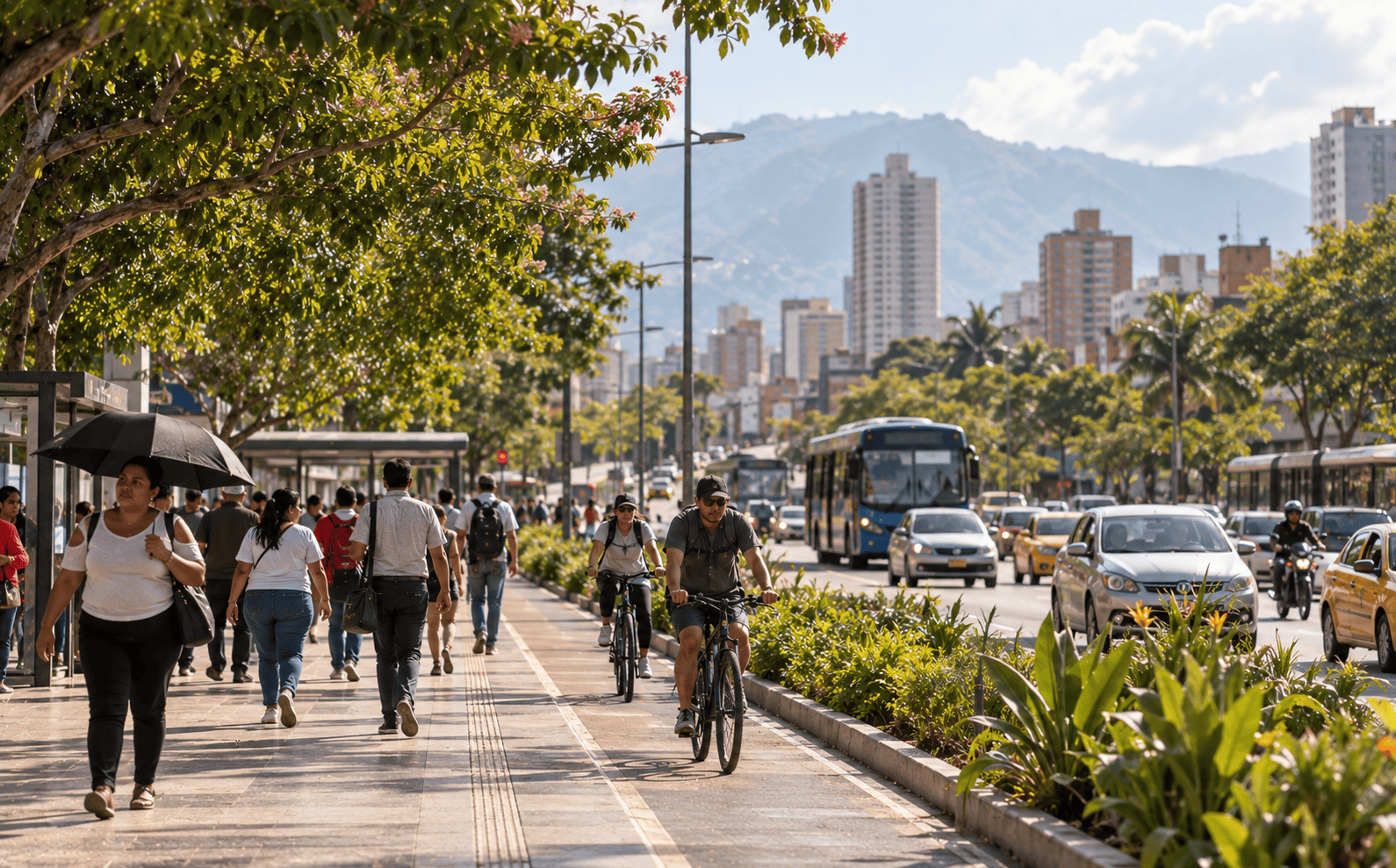
The project “Strengthening the consideration of climate change adaptation in urban planning,” led by MobiliseYourCity in partnership with CODATU and RESALLIENCE, marked a significant milestone in recognising the role of urban mobility in the face of climate challenges. Thanks to its collaborative and methodological approach, the Partnership helped deepen knowledge on city resilience while establishing MobiliseYourCity as a reference in a topic still little explored within the urban-mobility ecosystem.
Funded by ADEME and co-funded by AFD, the project sought to strengthen the integration of adaptation into international multilateral initiatives such as GlobalABC and MobiliseYourCity, through facilitation, studies, communications and training activities. The challenge of adapting our mobility systems to climate change is immense, and this project has covered only the initial exchanges; much remains to be done. It also enabled the development of capacity-building resources to help bridge data gaps at the intersection of urban mobility and climate resilience.
Project results
8 partners involved
10 dedicated workshops
2 publications (in 3 languages)
7 online articles
7 online training sessions (2 EN, 3 FR, 2 ES)
207 online participants
6 international event participations
Adapting urban mobility and the built environment to climate change — Nine principles for effective action
At the heart of the project is the publication of the Nine Principles for Adapting Urban Mobility to Climate Change, the result of a collaborative effort involving eight partners and ten workshops.
These principles provide a methodological framework to help cities design mobility infrastructure and policies capable of withstanding climate impacts such as flooding, extreme heat, storms, and sea-level rise.
International case studies illustrate how these principles are being implemented—from Beira (Mozambique) to Cartagena (Colombia), and from Durban (South Africa) to Toyooka (Japan)—showcasing the diversity of approaches and the value of nature-based solutions and integrated planning.
Integrating climate change adaptation into Sustainable Urban Mobility Plans (SUMP)
A second publication translates the nine (9) principles into concrete steps across the cycle of Sustainable Urban Mobility Plans (SUMPs) and National Urban Mobility Plans (NUMPs). This reflection draws on a stocktake of plans prepared with support from MobiliseYourCity, revealing that while climate awareness is advancing, adaptation actions remain limited and are rarely tested on the ground.
Driving Change Adaptation Actions for Urban Mobility - Catalogue of measures
A third publication, currently being finalised, will present concrete climate-resilience measures applicable to urban mobility systems.
Lessons learned from the project for the Partnership
Collaboration with ADEME proved to be a crucial strategic lever for the project. It helped consolidate relations with a key institutional partner, thereby strengthening the programme’s credibility and visibility. The role of the MobiliseYourCity Secretariat was decisive in ensuring continuity and mobilising new funding. Together with AFD financing, it provided a solid operational framework for rolling out activities.
This momentum was built on close collaboration with CODATU, a long-standing MobiliseYourCity partner. Opening up to the private sector—illustrated by cooperation with RESALLIENCE—also enriched the project by bringing valuable technical expertise on the climate resilience of infrastructure.
The launch of a working group dedicated to climate change adaptation strengthened exchanges among partners in the knowledge network, fostering experience-sharing and collective capacity building. This initiative sparked genuine interest in the topic and helped establish MobiliseYourCity as a recognised platform for coordination and knowledge management.
In response to growing demand for training, MobiliseYourCity acted quickly by developing learning materials and organising webinars and in-person training sessions. These activities helped raise awareness among a broad audience—particularly in member cities and countries, as well as other institutional and technical partners. However, their impact remains limited: the complexity of the subject and the lack of a dedicated budget call for more in-depth, better-resourced training. Moreover, the webinars often served more to raise awareness than to provide training, underlining that communication must go hand in hand with concrete technical support to translate into real action.
On the studies front, MobiliseYourCity conducted an in-depth analysis of Sustainable Urban Mobility Plans (SUMPs) and National Urban Mobility Plans (NUMPs), highlighting a lack of concrete action to integrate climate adaptation. Building on this foundation, the Partnership developed principles and methodologies to help cities better align mobility and resilience, while proposing a set of adaptation measures discussed in the working groups. These solutions still need to be tested in the field, and wider uptake will depend on the commitment and interest of local stakeholders.
In conclusion, the project confirmed MobiliseYourCity’s ability to bring together a diverse ecosystem of public, private and technical actors around a common goal: making urban mobility a central lever for climate change adaptation. While many milestones have been set, continued efforts—particularly through training, pilot implementation and the sharing of experiences—will be essential to turn these achievements into lasting impacts for partner cities in the Global South.