

What happens after a city adopts a sustainable urban mobility plan?
This question was at the centre of Yaoundé Sustainable Mobility Week, held from 16 to 18 June 2026 in Cameroon. Over three days, the event brought together Cameroonian institutions, African city representatives, technical partners and urban mobility practitioners to discuss a challenge shared by many cities: how to move from planning to implementation.
Organised by UNEP, GIZ and MobiliseYourCity, in collaboration with the Ministry of Housing and Urban Development of Cameroon, the Urban Community of Yaoundé and partners, the week focused on two essential but often underfunded pillars of urban mobility in African cities: active mobility and paratransit.
Yaoundé as a living case of implementation
Yaoundé provided a concrete starting point for the discussions. The city developed its Sustainable Urban Mobility Plan with support from MobiliseYourCity and is now advancing implementation through projects such as Mobilité Verte Yaoundé.
This made the event more than a technical workshop. It was an opportunity to look at what implementation really requires: institutions that coordinate, projects that are financially credible, streets that can be redesigned, and mobility solutions that respond to how people already move.
The discussions around Yaoundé’s SUMP, the MoVe Yaoundé project and the future BRT system showed that sustainable mobility is not delivered through one intervention alone. Major public transport investments, safer walking conditions, better public spaces and improved paratransit services all need to work together.
Active mobility as urban development
A strong message throughout the week was that walking and cycling should not be treated as secondary transport modes.
The launch of the French version of the Pan-African Action Plan for Active Mobility by UNEP was one of the key moments of the event. By making the framework more accessible to Francophone African countries and cities, it opened the door to broader policy uptake and stronger regional exchange.
Participants repeatedly connected active mobility to road safety, access to public transport, public health, climate action and social inclusion. In many African cities, walking is already the backbone of daily mobility. The challenge is to make it safer, more visible in planning processes, and better integrated into investment decisions.
City representatives shared concrete experiences from their own contexts, including school-based road safety, pedestrianisation, street design and access to transport. These exchanges showed that active mobility is gaining traction because it responds to immediate needs while also supporting longer-term urban transformation.
Public space: where mobility choices become political
One of the most engaging themes of the week was the management of public space.
Yaoundé, like many growing cities, faces competing demands on limited street space: pedestrians, taxis, vendors, parking, traffic, trees, waiting areas and public amenities all need room. Deciding how space is allocated is therefore not just a technical question. It is a governance question.
This became clear during discussions on spatial conflict management and during the interactive workshop on reallocating urban space. Participants worked with modular street elements to redesign a street and negotiate trade-offs between different uses.
The exercise helped make one point visible: implementation is where priorities become real. A mobility plan may define the vision, but the street is where choices have to be made.
Paratransit and active mobility belong in the same conversation
The week also highlighted the importance of discussing active mobility and paratransit together.
In Yaoundé and many other African cities, taxis and informal or semi-formal transport services are central to daily mobility. Walking is also essential to access these services. Improving one without considering the other risks missing how people actually travel.
Sessions on paratransit reform, taxi management and active mobility finance explored how cities can improve safety, service quality and organisation while keeping transport accessible. The discussions also showed that reform needs realistic financing mechanisms and close engagement with operators, institutions and users.
This connection between walking, public transport access and paratransit is particularly important for African cities, where mobility systems are often hybrid, flexible and highly dependent on local practices.
Learning from the street
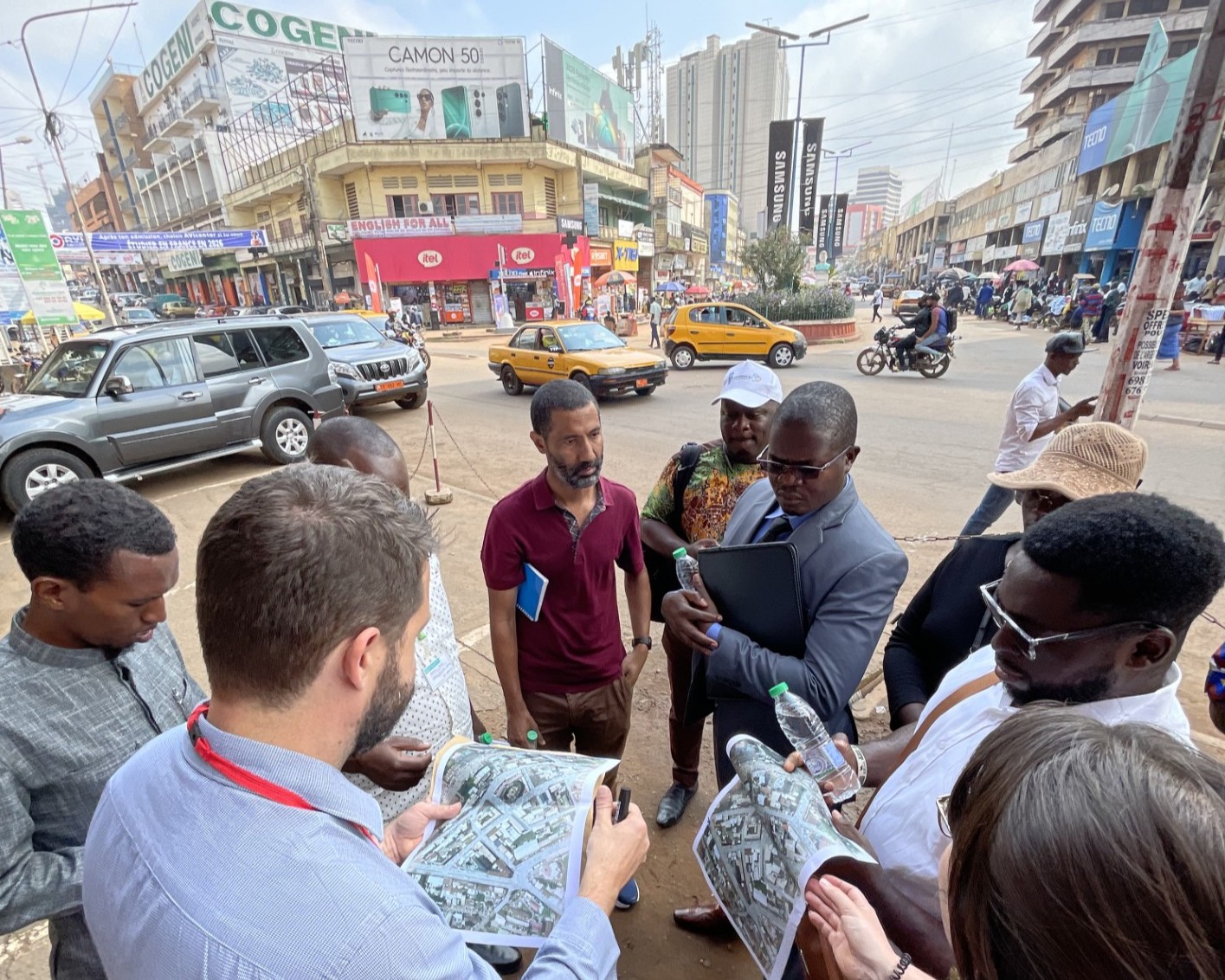
The field visit to the future MoVe Yaoundé intervention area was one of the clearest moments of the week.
A smaller group of participants walked through central Yaoundé with the project team to observe mobility conditions directly: pedestrian safety, road crossings, public space constraints, informal transport operations and accessibility challenges.
The visit helped connect the discussions to real streets and real users. It also created a different kind of peer exchange, where participants compared what they saw in Yaoundé with challenges in their own cities.
For mobility practitioners, this was an important reminder: implementation cannot be fully understood from a conference room. It has to be tested against the street.
A practical community of African cities
The strongest value of the week was the peer learning between African cities.
Representatives from cities including Bouaké, Dire Dawa, Mwanza, Antananarivo, Lomé and Bangui brought different experiences, but many of the questions were shared: how to finance projects, how to manage public space, how to improve walking conditions, how to work with paratransit operators, and how to keep momentum after a plan is adopted.
The high level of participation, the many questions during the panels and the energy in the workshops showed a clear demand for practical exchange. Cities are not only looking for methodologies. They want examples, lessons, tools and honest conversations about delivery.
For MobiliseYourCity, Yaoundé Sustainable Mobility Week confirmed that the next phase of sustainable urban mobility in African cities is about implementation. Plans remain essential, but their value depends on what they make possible: safer streets, more inclusive access, better public spaces and mobility systems that work for the people who use them every day.