

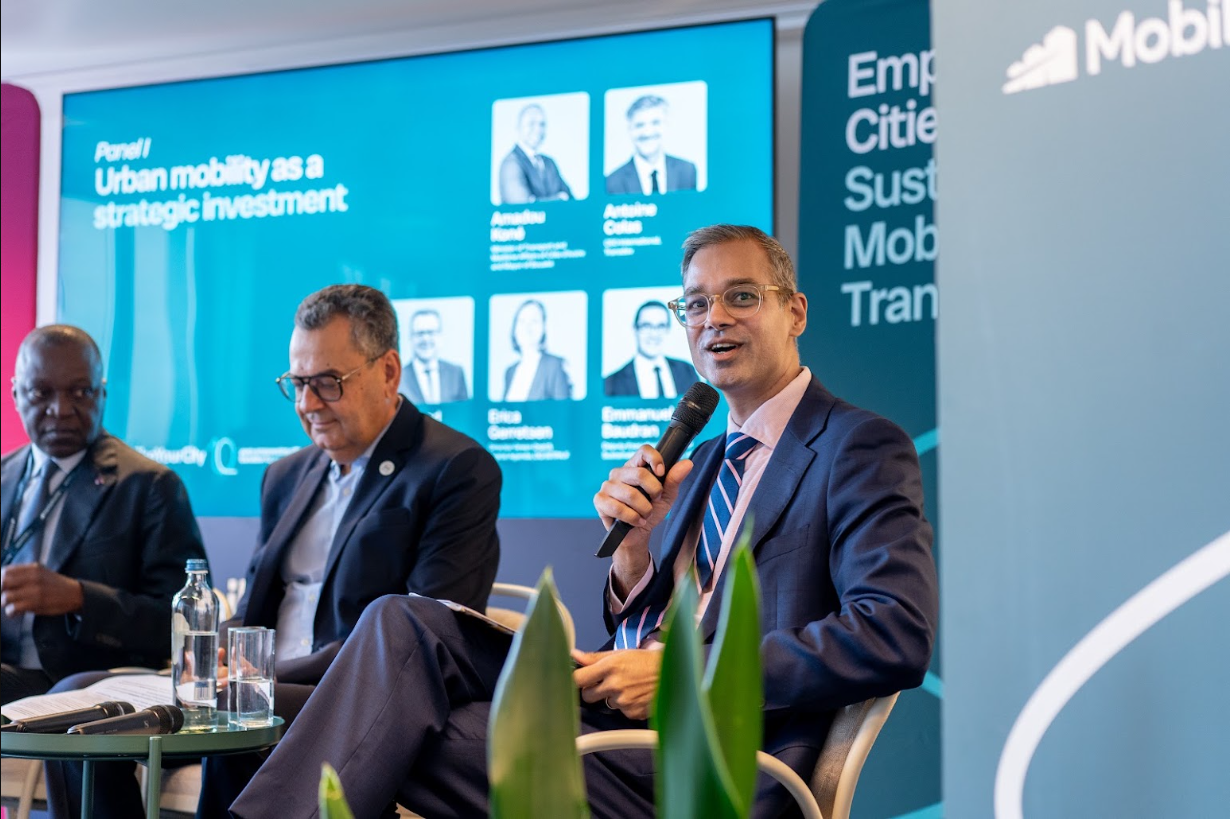
"We need to build on what has been done in the last ten years, turn it into a solid pipeline of projects and investments, and bring those investments to life together," - Erica Gerretsen, Director of DG INTPA Directorate F: Green Deal and Digital agenda
MobiliseYourCity marked its 10th anniversary in Brussels on the 1st of October. We brought together city and country members, partners and donors, and a community of friends of MobiliseYourCity to celebrate the occasion at Connecting Europe Days 2026. The discussion was notably forward-looking: after a decade supporting sustainable urban mobility planning, how can cities move more confidently from plans to implementation? Across three panels we heard from Amadou Koné, Minister of Transport and Maritime Affairs of Côte d'Ivoire and Mayor of Bouaké, Erica Gerretsen, Director of DG INTPA Directorate F, Emmanuel Baudran, Deputy Executive Director of Sustainable Development, Sebastian Lesch, Head of Cooperation at BMZ as well as a number of representatives from our partners and the private sector .Across three panels,
We also premiered What Moves Us, a short documentary following residents of Santo Domingo, Yaoundé and Medan, hosted the People in Motion street photography exhibition, and heard a testimony on the South African paratransit sector by Zonke Gavrilov.
Urban mobility as a question of connectivity
At Connecting Europe Days, much of the surrounding conversation focused on major intra-urban corridors, infrastructure and international connectivity. Mohamed Mezghani, Secretary General of UITP, offered a useful counterpoint: around 95% of people's mobility takes place in and around cities. The passenger traffic of Madrid airport is comparable to that of a single major metro station in the city. Connectivity includes trips between homes and jobs, schools and health services.
Ten years ago, much of MobiliseYourCity's work was about helping place sustainable urban mobility planning on the agenda. Today, we see the discussion around urban mobility shift to a wider debate around competitiveness, promoting investment opportunities and access to jobs.
From planning to implementation
Sustainable Urban Mobility Plans have been at the centre of MobiliseYourCity's work from the beginning. Done well, they help cities move beyond isolated projects and establish a shared direction across institutions and investment priorities.
The discussion on our anniversary showed the maturity of our approach. Wolfgang Backhaus of Rupprecht Consult stressed that there is no universal planning template. Understanding how a city actually works — its decision-making, institutional capacity, data, financing structures and political context — need before the formal planning process begins. In his words, external experts need to be “humble in the first steps.” Feasibility studies and technical work on priority projects can already advance while the wider mobility plan is being developed. The next challenge is to integrate the early stages of a plan into a more systematic approach.
As Jonathan Turgy of SYSTRA put it, a priority identified in a mobility plan is “not yet a project.” Moving from one to the other requires a clear project owner, evidence, governance, technical preparation and an initial route towards procurement and financing.
Squeezing timelines
Across the three panels, speakers returned to the same problem: cities are growing faster than projects are delivered. Mohamed Mezghani, Secretary General of UITP, said public transport often takes so long to develop that decision-makers hesitate to start projects they will not be in office to inaugurate.
"People are not waiting for us to finish our studies," said Amadou Ngounga Mouchili, Ministry of Housing and Urban Development, Cameroon. "If we do not deliver quickly, we risk delivering a project when its data is already out of date."
The solution most speakers proposed was practical: involve operators, engineers and financiers while plans are still being drafted. Transdev, RATP Dev, Systra, Rupprecht Consult and the European Commission all made the case.
Sergio Oliete Josa of the European Commission argued that bringing operators and private companies into the process earlier can help bridge the gap between planning and implementation. Their interest — or lack of it — can itself provide an early indication of whether a project is commercially and operationally realistic.
From the operator side, Wadii Bouchiha of RATP Dev Mobility Cairo made a similar point: decisions taken during design can influence the cost and performance of a system for decades. Operators who will eventually manage and maintain infrastructure can therefore add value long before operations begin. The private sector should be recognised as a source of knowledge needed to develop better projects earlier on in the cycle.
A more difficult financing environment
All this is taking place in a context that looks very different from 2015. Public budgets are under pressure and development finance is becoming more constrained. Anne Chaussavoine of AFD noted directly that reductions in aid budgets mean fewer grants and concessional loans, including fewer resources available for precisely the project-preparation activities needed to bring urban transport investments to maturity.
Projects will need to demonstrate readiness and projected impact. Development finance will increasingly need to be combined with other sources of capital. Local finance and private investment will need to play a greater role where possible.
At the same time, Emmanuel Baudran of AFD argued for moving beyond an older conception of development cooperation as one-way assistance. The language heard in Brussels was increasingly that of international partnership, mutual interest and sustainable investment, including the recognition that European institutions and companies also have things to learn from innovation emerging elsewhere.
Building the first chapter on the text ten years
The launch of MobiliseMENA during the anniversary offered a concrete view on the next phase. The new initiative will support the development and implementation of SUMPs and NUMPs in the EU Southern Neighbourhood, with targeted assistance for selected cities in Morocco and Tunisia, regional training and peer exchange. It is funded by the European Commission's Directorate-General for the Middle East, North Africa and the Gulf (DG MENA) with EUR 6.0 million and by the German Federal Ministry for Economic Cooperation and Development (BMZ) with EUR 0.65 million.
Morocco's Essaid Fraigui described their ambition in terms that could serve as a summary of much of the day's discussion: to strengthen the link between planning, project preparation, financing, implementation and evaluation.
"In the next decade we have to pick up the pace," said Sasank Vemuri, Head of MobiliseYourCity. "It would be easy to be cynical at a moment like this. What I heard instead were calls for action and for partnership."