

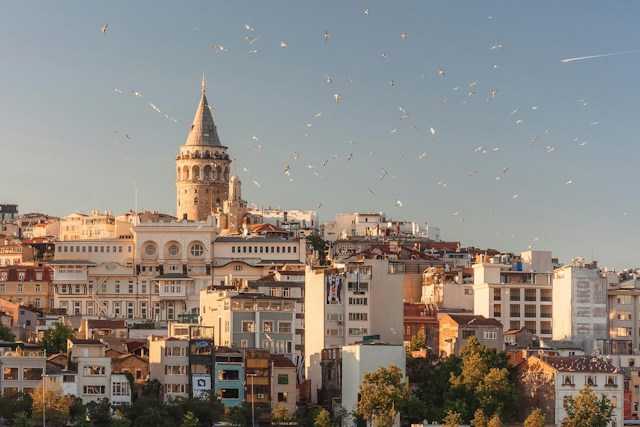
Istanbul Metropolitan Municipality governs one of the world’s largest and most complex urban mobility systems. Home to more than 15.6 million residents, Istanbul is Türkiye’s economic, cultural and logistical centre and a city whose daily functioning depends on the movement of more than 30 million trips each day. Through its membership in MobiliseYourCity, Istanbul seeks to strengthen an integrated, sustainable and climate-resilient mobility framework aligned with its Sustainable Urban Mobility Plan (SUMP) and long-term carbon neutrality objectives.
Its unique geography plays a decisive role in shaping Istanbul’s mobility patterns. The Bosphorus Strait, the Golden Horn and the Sea of Marmara physically divide the city, making intercontinental and intermodal travel highly dependent on a limited number of bridges, tunnels, maritime routes and transfer hubs. At the same time, legally protected forests and drinking water basins in the northern part of the metropolitan area restrict urban development, directing growth toward southern and western corridors. This spatial structure concentrates demand along key transport axes, increases pressure on capacity-constrained corridors and deepens inequalities in accessibility. Istanbul’s steep and fragmented topography further limits walking, cycling and micromobility, requiring specific solutions such as e-bikes, targeted infrastructure and multimodal integration.
Istanbul’s mobility system is large, diverse and heavily used. As of 2023, the city records approximately 30.2 million daily trips, with 28 percent made by public transport, 16 percent by shuttle services, 16 percent by private care and 41 percent by active modes including walking, cycling and micromobility. Walking accounts for a significant share of trips, particularly for short distances and first- and last-mile access, yet pedestrian safety and infrastructure quality remain uneven. Road safety remains a major concern for pedestrians and cyclists, who face disproportionate risks due to limited protected infrastructure. While being widely used for medium- and long-distance trips, public transport faces challenges related to capacity, congestion and intermodal integration. Private car ownership continues to rise, contributing to severe congestion, long travel times and high emissions.
Despite these challenges, Istanbul has made substantial progress in recent years. Guided by its SUMP, the city has expanded its rail network to more than 262 kilometres, with an additional 208 kilometres currently under construction and ambitious targets to reach over 800 kilometres by 2040. Istanbul has also invested in active mobility, with the cycling network now exceeding 565 kilometres and micromobility parking areas being installed near public transport hubs and public spaces.
Key reforms have focused on integration and system efficiency. These include the restructuring of paratransit services through the conversion of minibuses into regulated taxis, pilot fare integration through the Istanbulkart system, and the expansion of park-and-ride facilities to encourage modal shift from private cars to public transport. Currently underutilised maritime transport opportunities are being used by creating and building new routes, sea taxis, upgraded piers and improved integration with rail services. Istanbul has also advanced regulatory frameworks for shared bicycles, e-scooters and school safety zones, reinforcing its commitment to safe and inclusive mobility.
Environmental sustainability is a central pillar of Istanbul’s mobility strategy. Transport accounts for approximately 26 percent of the city’s greenhouse gas emissions, with nearly all emissions originating from motorised road transport. In response, Istanbul has set ambitious targets to reduce transport-related emissions by 94 percent and per capita emissions by 60 percent by 2040, with full carbon neutrality by 2050. Measures include low-emission zones in central districts, the electrification of the metrobus fleet, the promotion of walking and cycling, and a comprehensive monitoring framework to track environmental and social impacts.
By joining MobiliseYourCity, Istanbul Metropolitan Municipality aims to reinforce its capacity to implement these ambitions. Membership will provide a platform for peer learning, technical cooperation and access to global best practices, enabling the city to share its experience as a transcontinental megacity while learning from others facing similarly complex challenges. Through this partnership, Istanbul seeks to advance a more sustainable, accessible and resilient urban mobility system for all its residents.