

Introduction
Urban mobility planning has historically centred on the needs and experiences of men. Only recently has there been growing attention to gender in urban mobility, especially in relation to women’s safety and travel patterns. This shift is slowly taking place in both the Global North and the Global South, however, other forms of invisible mobility, such as those of queer people still remain largely absent from research, planning, and practice.
Knowledge on the experiences of queer people[1] when moving through the city are extremely limited and the little existing research focuses on cities in the Global North, such as London, Brussels, Barcelona or Tel Aviv. These studies offer important insights, but they are not easily transferable to other contexts and geographies, where social norms, legal frameworks, and urban conditions can differ significantly.
Everyday mobility: necessity and exclusion
Despite the lack of research, existing evidence points to some common risks and challenges that queer people encounter when navigating urban mobility: Mobility spaces reflect the same social hierarchies found elsewhere in the city, meaning they may experience harassment, exclusion, and violence in streets, stations, and vehicles.
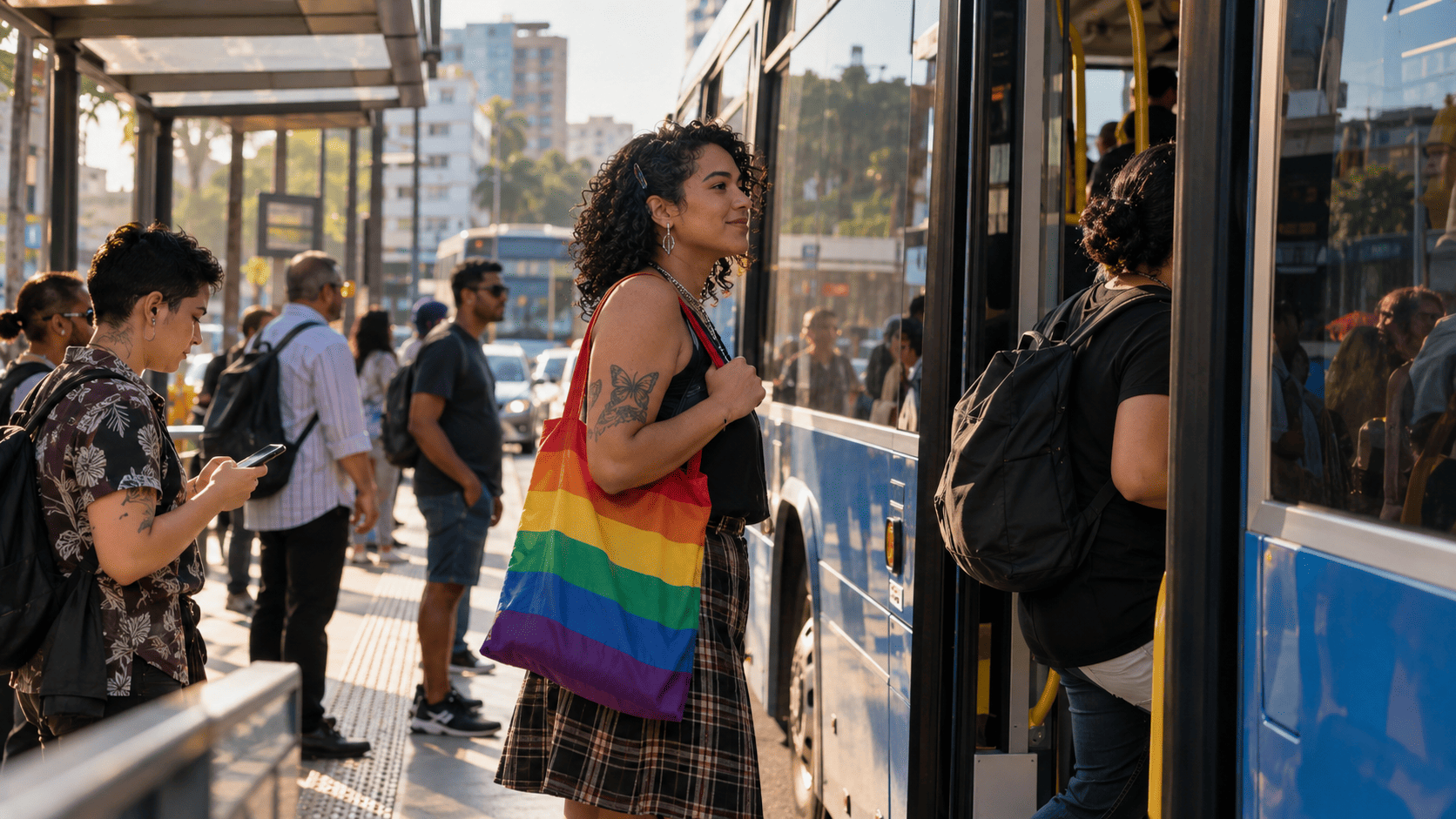
Mobility is not optional. It is essential for accessing work, education, and social networks. Yet it often requires queer people to remain highly alert. This constant awareness affects how they move through the city, including which routes they choose, what modes they use, and how they present themselves. Moving through the city often presents a continuous negotiation of choices concerning safety, convenience and self-expression. In this context, experiences are shaped by intersectionality. Queers of colour, disabled queers, queer women, trans women, and gender non-conforming individuals often face compounded forms of discrimination. That said, violence and harassment are especially pronounced for those who are visibly gender non-conforming.
Public transport presents particular constraints. Waiting at stops and remaining inside vehicles limits the ability to leave uncomfortable or unsafe situations. By contrast, active modes such as cycling can offer more independence, flexibility, and speed, which some people, use as a strategy to reduce exposure to risk. In Brussels, it was found that especially people perceived as women used cycling as a way to avoid being harassed. However, the actual and perceived safety of different modes vary significantly for each city depending on circumstances such as availability, reliability and predictability of public transport services, lighting, security cameras, and actual and perceived competency of transport staff. Overall, access to different mobility modes may vary greatly between cities and in different geographies and cultures.
Social networks and access to the city
Access to mobility and the city is closely linked to access to social networks. For many queer people, queer communities and spaces play a central role in wellbeing, belonging, and social support, particularly when family support is limited or absent. This makes the ability to travel across the city especially important.
In many cases, inclusive and queer spaces are concentrated in larger urban centres. Reliable and affordable transport from peripheral or rural areas to these centres is therefore critical. Without it, access to social support, cultural spaces, and collective identity becomes restricted.
At the same time, queers are more often economically disadvantaged, living in lower income neighbourhoods, and are less likely to own private vehicles. This increases dependence on public transport, even though these systems are not designed with their needs in mind. Planning discourse continues to overlook the very groups that rely most heavily on collective transport systems, including queers and women.
Invisible costs and adaptive strategies
Queer people have long developed strategies to navigate unsafe environments. These include modifying behaviour, altering appearance, or avoiding certain routes and times. While these practices enable mobility, they come at a cost both economically and psychologically.
These costs are largely invisible in planning processes. It includes the emotional burden of constant vigilance, the restriction of self-expression, and the need to prioritise safety over comfort or efficiency. These trade-offs and adaptive strategies, such as changing clothing or behaviour when moving between different spaces, shape everyday mobility decisions but are rarely captured in transport data or policy frameworks.
From invisibility to inclusion
Addressing queer mobilities requires moving beyond symbolic recognition towards structural change. Some transport authorities have begun to acknowledge these issues. For example, Transport for London has started data collection on the needs of diverse communities and implemented staff training and awareness measures, alongside campaigns that address harassment and discrimination. More data and knowledge on experiences and needs of queer mobilities are needed across all geographies, but especially also Global South cities.
Improving safety is a central concern. This can include better lighting, visible staff presence, and clear reporting mechanisms that are taken seriously.
Service provision must also respond to actual travel patterns. Increasing frequency at night and on weekends can improve accessibility for queer communities. Reliable services and information on waiting times and well-maintained infrastructure can further reduce uncertainty and stress.
At the same time, visibility initiatives such as inclusive imagery or symbols can contribute to a sense of recognition, but they must be accompanied by substantive measures. Without this, they risk becoming performative.
Finally, meaningful inclusion depends on participation. Queer communities need to be involved in planning, implementation, and evaluation processes. This requires not only consultation, but also recognition of lived experience as a form of expertise.
Bibliography
Van Vessem, C., Betancur Arenas, J., & Keserü, I. (2025). Queer Mobilities and Spatial Practices in Brussels | Brussels Centre for Urban Studies. Urbanstudies.brussels. https://urbanstudies.brussels/queer-mobilities-and-spatial-practices-brussels
Weintrob, A., Hansell, L., Zebracki, M., Barnard, Y., & Lucas, K. (2021). Queer mobilities: critical LGBTQ perspectives of public transport spaces. Mobilities, 16(5), 775–791. https://doi.org/10.1080/17450101.2021.1958249
[1] The term queer refers to people whose sexual orientation, gender identity, or gender expression falls outside heterosexual and cisgender norms.